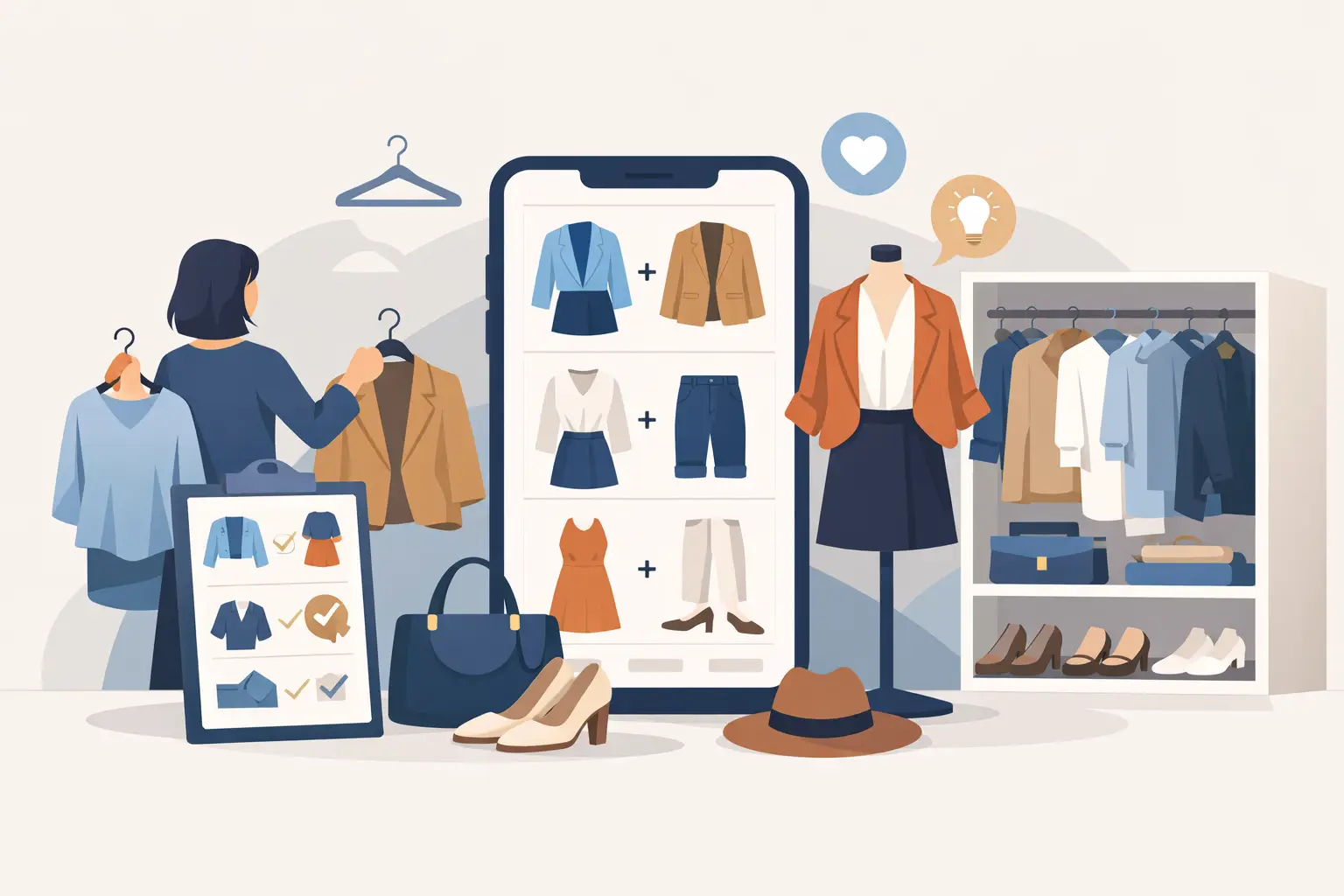
You know the moment - your closet is full, but getting dressed still feels like a bad search result. Too many pieces, not enough clarity. Outfit planning from wardrobe works better when you stop treating clothes as isolated items and start seeing them as combinations that need to earn their place.
That shift matters because most wardrobe problems are not actually shopping problems. They are visibility problems. You may already own enough to build strong looks for work, weekends, dinners, and travel, but if you cannot quickly see what goes together, you default to the same safe outfit on repeat. The result is wasted time, wasted purchases, and a closet that feels less useful than it is.
Why outfit planning from wardrobe usually breaks down
Most people do not struggle because they lack style. They struggle because their wardrobe lives in fragments. A pair of pants is in one mental bucket, a jacket is in another, and the shoes that would make the outfit work are forgotten until you are already late.
There is also the fit problem. An outfit can look right in theory and still fail on your body. Proportions change everything. A top that works with high-rise denim may fall flat with tailored trousers. A coat that looks sharp over a fitted dress may overwhelm a looser one. This is where planning often stalls. You can make a smart list of pieces on paper and still end up with an outfit that feels off once it is on.
The old solution was to physically try on multiple combinations and hope one clicked. That takes time, creates mess, and still leaves room for second-guessing. For online shoppers, the uncertainty gets even worse. You are not only planning from what you own. You are trying to predict how a new item will work with your existing wardrobe before you buy it.
A better way to approach outfit planning from wardrobe
Start with roles, not just clothes. Every strong wardrobe has a few categories doing heavy lifting: anchor pieces, supporting basics, statement items, and finishers. Anchor pieces are the items that can carry an outfit on their own, like great jeans, wide-leg trousers, a clean blazer, or a simple black dress. Supporting basics are the pieces that make those anchors easy to wear repeatedly. Statement items add personality. Finishers - shoes, bags, outerwear, and jewelry - determine whether the outfit reads polished, casual, or unfinished.
When you see your wardrobe through those roles, planning gets faster. Instead of asking, "What should I wear?" you ask, "Which anchor am I building around, and what supports it?" That is a much easier problem to solve.
From there, focus on repeatable formulas. Most people do not need endless originality every morning. They need 5 to 10 formulas that reliably work. Think fitted top plus relaxed pants plus structured outerwear. Or knit dress plus tall boots plus long coat. Or denim plus crisp shirt plus loafers. The formula gives you speed. The individual pieces give you variety.
This approach also exposes gaps more clearly. If three outfit formulas depend on one pair of shoes that is uncomfortable, that is a useful signal. If all your best outfits require a layer but none of your jackets fit right, that is another. Smart planning makes shopping more precise.
See your wardrobe as outfits, not inventory
This is where digital tools change the experience. A wardrobe catalog is helpful, but a wardrobe system is better. The difference is simple: inventory tells you what you own. Outfit planning shows you what works.
Seeing combinations on your body changes decision-making fast. You can test proportion, color balance, and overall vibe before pulling half your closet onto the bed. You can also revisit looks instead of rebuilding them from memory. That matters on busy weekdays, before trips, or when you are considering a purchase and want to know whether it has real outfit potential.
A virtual try-on app like Prova fits naturally here because it closes the gap between idea and proof. You can upload a full-body photo, try clothing digitally, and view realistic styling results in about 10 seconds. That speed matters. Planning should reduce friction, not create another task. If you can test a combination quickly, you are more likely to experiment beyond your default uniform.
The confidence piece matters just as much. If you shop online often, the real question is rarely, "Do I like this item?" It is, "Will this item work with what I already own, on my body, in real life?" Visual certainty is what cuts returns. It also prevents the common mistake of buying a good item that does not fit your wardrobe.
How to build a wardrobe planning system you will actually use
Keep it simple enough to repeat. The best system is the one you can maintain in minutes, not hours.
First, identify your top-use scenarios. For most people, that means some version of work, casual daytime, going out, event dressing, and travel. Your wardrobe should support the life you actually live, not the one you occasionally imagine. If 70% of your week is casual and hybrid work, planning should reflect that reality.
Next, map your most reliable base pieces. These are the items you reach for constantly because they fit well and pair easily. Build around them first. It is tempting to start with the exciting pieces, but planning gets traction from the dependable ones.
Then test combinations in batches. Instead of planning one outfit under pressure each morning, create several looks at once. A single pair of trousers might generate three distinct outfits depending on the top, outerwear, and shoes. Once those combinations are saved, the effort compounds. You stop starting from zero.
This is also the moment to be honest about weak links. If an item only works with one very specific pairing, it may still deserve a place, but it is not versatile. If a piece looks good alone but consistently disrupts your best outfits, that is useful information. Wardrobe planning is not about forcing every item to be a hero. It is about making your closet easier to use.
Where AI helps - and where your judgment still matters
AI is great at speeding up visualization and surfacing combinations you might miss. It can help you test styling directions quickly, compare options, and keep your wardrobe organized in a way that is actually actionable.
But style is still personal. The best outfit is not always the most trend-forward one or even the most balanced one. Sometimes you want sharp and minimal. Sometimes you want comfortable and low-effort. Sometimes you need an outfit that survives a long commute, office AC, and dinner after work. Context changes the answer.
That is why the strongest planning tools support your decisions instead of replacing them. Fast try-on, saved looks, and outfit recommendations are most useful when they give you clarity, not when they push a one-size-fits-all formula. Good technology should help you get to yes faster. It should also help you reject a bad buy before it lands at your door.
Privacy matters here too. If you are uploading photos to test looks, security cannot be an afterthought. That trust layer is part of the product experience. Encrypted processing and automatic photo deletion are not side features. They are table stakes for anyone who wants convenience without giving up control.
The real payoff of better outfit planning
The obvious benefit is speed. You spend less time changing, less time second-guessing, and less time buying pieces that do not integrate. But the bigger benefit is accuracy. You start making decisions based on evidence instead of hope.
That changes how you shop. You buy fewer random maybes. You spot true gaps sooner. You can tell when a new item expands your wardrobe versus when it simply adds volume. Over time, your closet gets smaller in the right places and stronger in the ones that matter.
It also changes how you feel getting dressed. There is a noticeable difference between throwing something on and wearing a look you already know works. One creates low-level friction all day. The other frees up mental space.
If your wardrobe feels crowded but not productive, the answer is rarely more clothes. It is a clearer system. Start by seeing what you own as usable combinations, test them on your body, and save the ones that prove themselves. The best outfit plan is not the most ambitious one. It is the one that makes tomorrow morning easy.