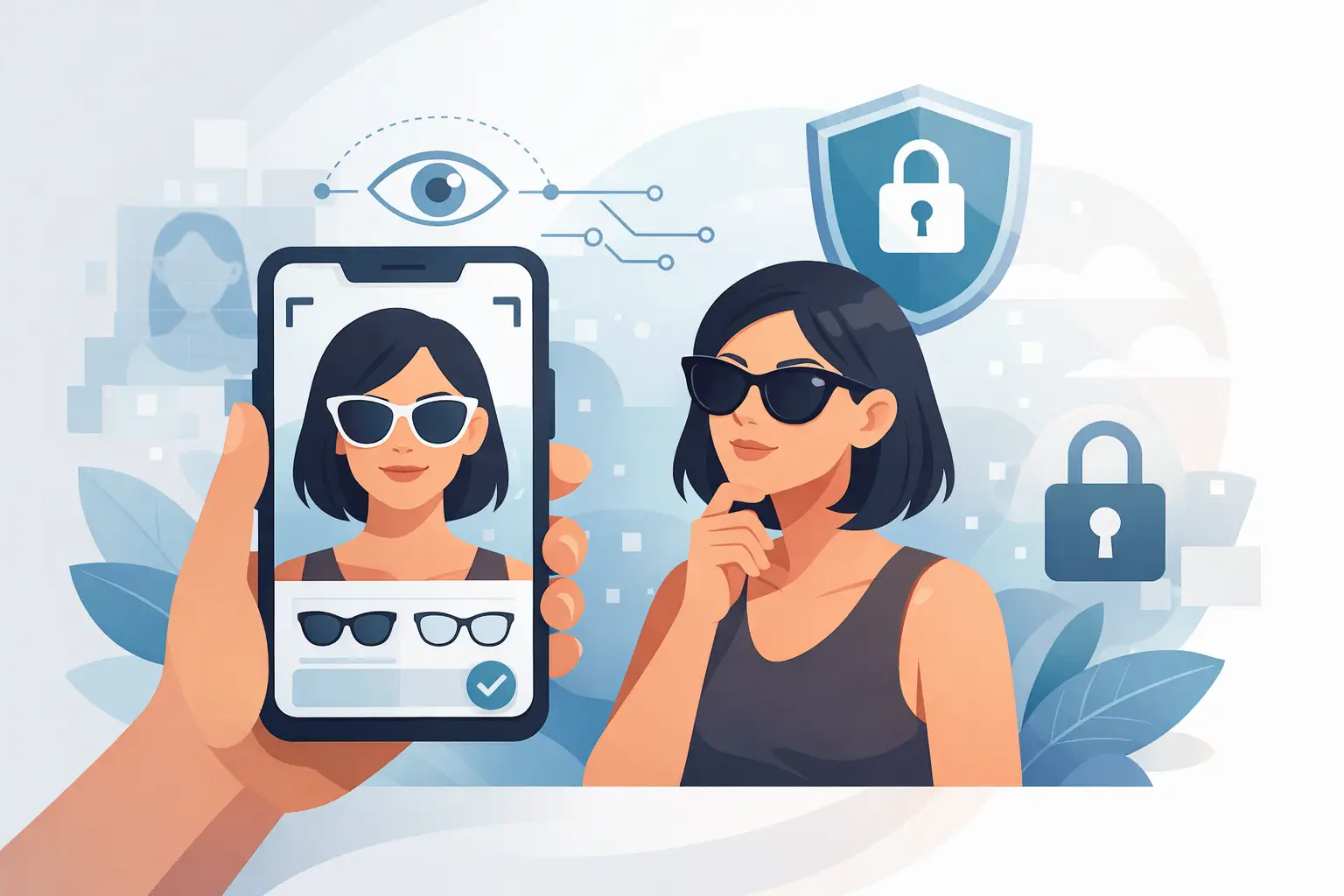
Uploading a full-body photo to test an outfit can feel easier than stepping into a fitting room. It can also feel a little risky. If an app asks for your image, your first question should be simple: where does that photo go, and what happens to it after the try-on is done?
That is the real answer behind the question, is virtual try on safe for personal photos. The technology itself is not automatically unsafe. The difference comes down to how the app handles your data, how long it keeps it, and whether the company is clear about its privacy practices.
Is virtual try on safe for personal photos? It depends on the app
Virtual try-on uses AI to detect your body shape, position, and proportions, then place digital clothing over your image. To do that, the system has to process a personal photo. In many cases, that means your image is uploaded to cloud servers, analyzed, and turned into a try-on result.
That process is normal. The privacy question is what happens next.
A safer app will use encrypted connections while your photo is uploaded and processed. It will also explain whether the original image is stored, how long it is retained, and whether it is deleted automatically after processing. If the company is vague on any of those points, that is where concern should start.
So yes, virtual try-on can be safe for personal photos. But only when the platform treats your photo as sensitive data, not as a free asset for indefinite storage, model training, or marketing reuse.
What actually happens to your photo during virtual try-on
Most users imagine a virtual fitting room as a simple overlay. In reality, the system usually runs several steps in the background.
First, your photo is uploaded. Then the AI identifies the outline of your body, key points like shoulders and hips, and the angle of your pose. After that, the clothing image is mapped onto your body so the final result looks realistic rather than pasted on. Depending on the app, the result may also be saved to your account so you can revisit outfits later.
None of that is inherently a problem. The issue is that every step creates a privacy decision. Is the upload encrypted? Is the original photo kept? Is the processed image linked to your account? Is it used to improve the model? Can it be deleted if you stop using the app?
These are not edge-case details. They define whether a virtual try-on experience is private or merely convenient.
The real privacy risks users should watch for
The biggest risk is not usually that someone is spying on your outfit session. It is poor data handling behind the scenes.
If a platform stores personal photos longer than necessary, that increases exposure in the event of a breach. If it uses uploaded images for AI training without a clear opt-in, your photo may end up supporting future product development in ways you did not expect. If privacy terms are broad or hard to understand, you may be agreeing to more than a simple fitting-room experience.
There is also a difference between storing the image itself and storing data derived from it. An app may delete the original photo but still keep generated outputs, body mapping data, or account-linked try-on history. That can be useful if you want a wardrobe feature or saved looks. It also means users should know what is retained and why.
For teens and younger shoppers, this matters even more. A full-body image is personal. Even when the use case is fun and practical, the privacy bar should be high.
How to tell if a virtual try-on app is safe
You do not need a technical background to vet an app. You just need to look for direct answers.
Start with the privacy language. If the company clearly says photos are transmitted over encrypted connections and automatically deleted after processing, that is a strong sign. If it hides behind general statements like "we care about your privacy," that is not enough.
Next, check whether the app explains account storage. Some features are designed to save your looks, which can be helpful if you want to compare outfits before buying. That is a fair trade-off if the user chooses it and understands it. It is less acceptable if images are retained by default without a clear reason.
You should also look for signs of restraint. A trustworthy app only asks for the data it needs to generate accurate results. It does not ask for unrelated permissions, and it does not make you guess how your image will be used.
Strong safety signals usually include these four basics:
- Encrypted upload and processing
- Automatic deletion of photos after processing, when possible
- Clear explanation of what is saved to your account
- Straightforward privacy terms written for normal people
If an app checks those boxes, you are looking at a much safer experience.
Is cloud processing a problem?
Not by itself. In fact, cloud processing is often what makes near-instant virtual try-on possible. It allows advanced AI systems to create more realistic results in seconds instead of forcing your phone to do all the work.
The trade-off is simple. Speed and accuracy often improve when cloud infrastructure is involved, but privacy depends on how that infrastructure is managed. Secure cloud processing with encryption and automatic deletion can be a strong setup. Unclear storage policies on cloud servers can be a weak one.
So the question is not whether cloud processing exists. The question is whether the company has built guardrails around it.
Why automatic deletion matters
If a photo is only needed to generate your try-on result, keeping it forever makes little sense. Automatic deletion reduces the amount of sensitive data sitting on servers. Less stored data usually means less long-term risk.
This is one of the clearest trust signals in virtual try-on. When a platform states that uploaded photos are automatically deleted after processing, it shows discipline. It means the company is designing for privacy, not just talking about it.
There are cases where storage is useful. If you want a saved outfit history or a digital closet, some results may need to remain attached to your account. That can still be privacy-conscious if the app is transparent about what is stored and gives you control over it.
Is virtual try on safe for personal photos if you want saved outfits?
Yes, but this is where trade-offs become real.
Saved outfits are convenient. They let you compare looks, revisit past try-ons, and build a wardrobe over time. For frequent online shoppers, that can make buying decisions faster and cut down on returns. But saved content means some version of your try-on experience may remain in the system.
That does not make the feature unsafe. It just means the safest app is not always the one that stores nothing at all. Sometimes it is the one that stores only what supports the feature, protects it properly, and gives users control.
A modern virtual fitting room should feel both useful and secure. You should not have to choose between realistic results and responsible privacy practices.
A practical standard for safer try-on
If you are deciding whether to trust a virtual try-on app, use a simple filter. Ask whether the company is fast, clear, and disciplined.
Fast means the experience is built for real shopping behavior, not friction. Clear means the privacy practices are spelled out in plain English. Disciplined means personal photos are encrypted, handled for a specific purpose, and deleted when they are no longer needed.
That standard is why privacy-forward design matters as much as AI accuracy. A virtual try-on tool should help you shop with more confidence, not create new uncertainty about your personal data. On platforms built this way, including privacy-focused options like Prova, the goal is straightforward: get a realistic result in about 10 seconds, keep the process secure, and automatically delete photos after processing.
The best virtual try-on experience should feel simple the whole way through. You upload a photo, see the fit, make a smarter decision, and move on without wondering where your image ended up.