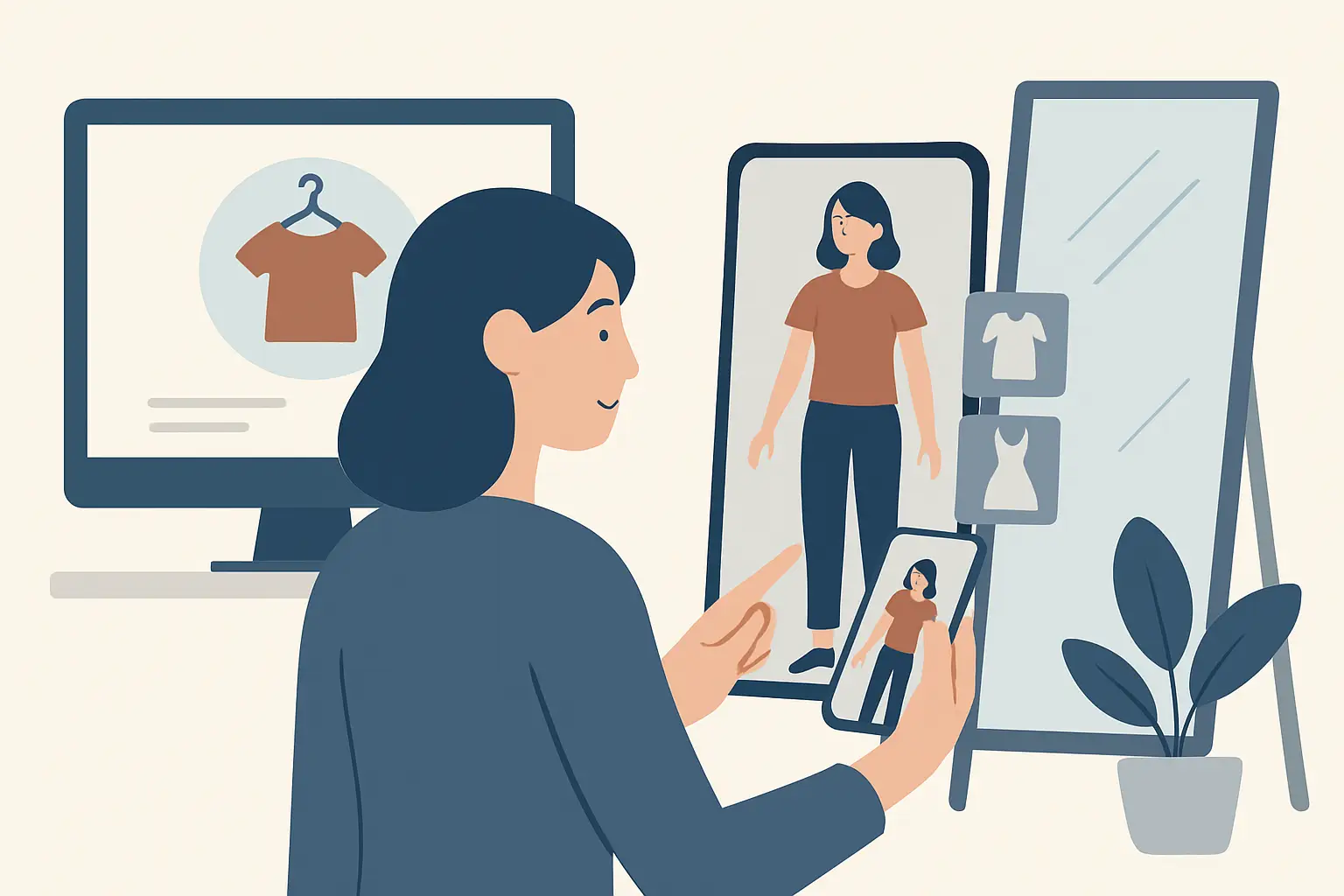
You know that moment: the cart is full, the color is right, the reviews are decent - and you still pause because you cannot picture the fit on you. Not “on the model.” Not “on someone who is 5'9" and wearing a size small.” On your body, in your lighting, with your proportions.
That hesitation is why the virtual fitting room app category is exploding. People do not need more product photos. They need clarity. The best apps make buying feel closer to trying on, without the dressing-room line, the bad mirror, or the return label.
What a virtual fitting room app is really solving
Most shoppers think the problem is sizing. It is, but only partly. The bigger problem is uncertainty - and uncertainty shows up in a few predictable ways.
First, you are guessing how a garment will hang on your shape. Two people can wear the same numeric size and get completely different results because of shoulder width, torso length, hip shape, or where the fabric pulls.
Second, you are guessing styling. Even when something “fits,” it might not fit your vibe. A jacket could look sharp with one pair of jeans and awkward with the shoes you actually wear.
Third, you are guessing effort. If an item requires special underlayers, tailoring, or constant adjusting, it becomes a closet tax - money spent on something you avoid.
A virtual fitting room app is effective when it reduces those guesses fast and visually. Not with charts. Not with generic “true to size” badges. With a try-on preview that looks like you.
How virtual try-on works (and what affects realism)
Virtual try-on typically starts with a full-body photo. The app uses AI to understand your silhouette and body landmarks, then digitally overlays clothing so it follows your pose and proportions. The output is not magic - it is computation - and the quality depends on inputs and processing.
Photo quality matters more than people expect. Clear lighting, a simple background, and a full-body frame help the AI map your shape accurately. If your photo is cropped at the ankles or the lighting is harsh, the preview can look off even if the app is strong.
Garment data matters too. Some experiences use brand-provided images, some use catalog photos, and some allow you to upload screenshots. The more the app can infer about the garment’s structure, the more convincing drape and placement will be.
Then there is speed. If a try-on takes too long, people abandon it and go back to guessing. Fast processing is not just a nice-to-have. It is the difference between “I’ll try one more outfit” and “forget it.”
The biggest benefits you should expect
A good virtual fitting room app should create real outcomes, not just a fun visual.
The first outcome is fewer returns. Returns are time, shipping, repackaging, and the nagging feeling that you made a bad call. When you can preview how something sits on your shoulders or where the hem hits, you make cleaner decisions.
The second is faster checkout decisions. Instead of opening ten tabs and cross-referencing reviews, you get a direct visual signal. It is not perfect certainty, but it is better certainty.
The third is more outfit experimentation. When you can test combinations quickly, you get braver with silhouettes and styling. That turns shopping from “please let this work” into “let’s see what looks best.”
Where virtual fitting room apps still fall short
This is where it depends. Virtual try-on is great at appearance and proportion, but it has limits.
Fabric behavior is hard. A stiff denim jacket versus a soft knit cardigan can look similar in a flat image, yet feel totally different in motion. Some apps simulate drape better than others, but none can fully replace the tactile part of trying on.
Compression and stretch are also tricky. Leggings, shapewear, ribbed tanks - these items change how they sit depending on tension. A visual preview can guide you, but it cannot tell you how it will feel.
And then there is sizing policy reality. A preview might show you that a dress looks great, but if the brand’s size run is inconsistent, you still have to choose a size. The best experience is visual try-on plus sizing guidance, not one or the other.
What to look for in a virtual fitting room app
Not all apps are built for everyday shoppers. Some are demos, some are retailer-specific, and some feel like toys. If you want something you will actually use, prioritize these criteria.
Speed you can feel
If the promise is “quick,” you should see results quickly. When try-on is near-instant, you naturally test more options. That is where the value compounds: more comparisons, fewer regrets, better outfits.
Accuracy that respects your proportions
Look for try-on previews that keep clothing aligned with your body - waist placement, shoulder seams, hem length. If tops float off the torso or pants slide oddly, you will stop trusting the output.
Privacy that is explicit, not implied
You are uploading a full-body photo. That is sensitive, and the app should treat it that way. The best privacy posture is clear and specific: encrypted connections and automatic deletion after processing. Vague statements like “we care about privacy” are not enough.
A way to save and compare outfits
The real workflow is not try once and leave. It is try, save, compare, revisit, share, then buy. A built-in wardrobe or saved looks feature is what turns a one-off novelty into a daily shopping utility.
Style help that feels practical
Recommendations should help you decide, not overwhelm you. Simple styling tips, outfit pairings, and color suggestions are useful when they are grounded in what you are trying on, not generic trend content.
A practical workflow that makes try-on worth it
If you have ever downloaded a shopping app and forgotten it a day later, the fix is a repeatable flow. Here is a realistic way to use a virtual fitting room app so it actually saves you time.
Start with one clear full-body photo you like. Treat it as your “base model” - the photo you will use for most try-ons. Good lighting and a simple outfit (think fitted top and leggings) make results more readable.
When you shop online, screenshot items you are considering and run try-ons in batches. Do not do it one-by-one while you scroll. Ten minutes of focused try-on beats an hour of indecision.
Save the best looks into collections that match your life: work, weekend, gym, date night, trip packing. When you are in a rush, you will thank yourself.
Before you check out, compare the top two options side-by-side. The goal is not perfection. The goal is a confident pick.
Online and offline shopping both benefit
Virtual fitting rooms are often framed as e-commerce tools, but they also help in-person shopping.
If you are in a store and do not want to try on ten items, use try-on previews to narrow to the two that look most promising. If you are shopping with friends, it can also cut down on the “wait, let me change again” cycle.
And if you are mixing shopping channels - buying online, returning in-store, browsing in-store, ordering online - a single saved wardrobe of try-ons keeps your decisions consistent.
Why “fun” is not a distraction - it’s retention
People share outfits when they feel good about them. That sharing is not just social. It is a decision tool. If you can send a try-on to a friend and get a quick yes or no, you avoid impulse purchases that sit in your closet with tags.
A virtual fitting room app that makes experimentation enjoyable gets used more often. And frequency matters. The more you use it, the more you reduce returns and dead-on-arrival buys.
A note on Prova
If you want a consumer-first option designed for fast, realistic try-on, Prova is built to deliver a preview in about 10 seconds, with encrypted connections and automatic photo deletion after processing. It also includes a My Wardrobe feature so you can save looks and come back when you are ready to buy.
The trade-off you’re really choosing
Every shopping decision is a trade: time versus certainty. You can spend time reading reviews, measuring yourself, and ordering multiple sizes, or you can use visual confirmation to get to “yes” faster.
A virtual fitting room app does not eliminate judgment. It upgrades it. You still choose what you like, what fits your budget, and what works for the occasion. The difference is that your decision is based on seeing, not hoping.
The next time you are stuck on a purchase, do one thing before you close the tab: try it on virtually, save the look, and sleep on it. Confidence is a better shopping high than any discount code.