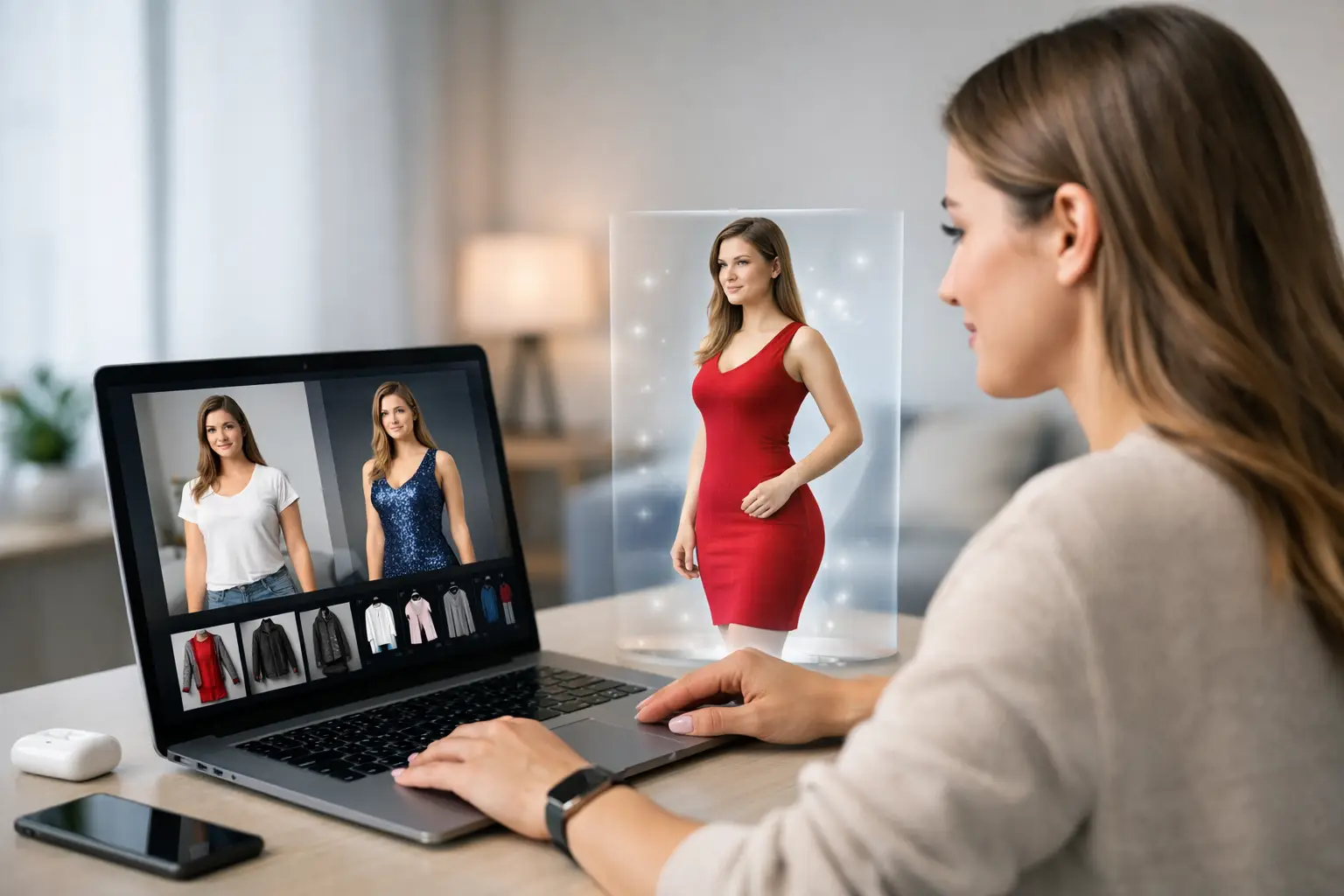
You can decide on a meal delivery order in two taps, but buying a jacket online still feels like a gamble. That gap is exactly why the future of virtual clothing previews matters. Shoppers want visual proof before they buy, not another size chart, vague model photo, or expensive return.
Virtual try-on has already moved past novelty. The next phase is about speed, realism, and trust. If a preview takes too long, looks fake, or raises privacy concerns, people will abandon it. If it shows how a garment actually falls on your body in seconds, it changes how you shop.
Three forces are pushing this category forward at once. Online shopping is still growing. Return costs are hurting both shoppers and retailers. And phone cameras, cloud processing, and AI image generation have improved fast enough to make previews feel useful instead of experimental.
That timing matters. A few years ago, many virtual try-on tools looked stiff or worked only on a narrow set of bodies and garments. Now the bar is different. Consumers expect realistic drape, better fit visualization, and near-instant results. They also expect privacy protections that are clearly stated, not hidden in fine print.
The result is a market shift from "nice feature" to "decision tool." For frequent shoppers, virtual previews are becoming part of the buying process itself.
From static mockups to personal fit confidence
Early systems often treated clothing previews like simple overlays. A top was pasted onto a photo and roughly resized. That could be fun for social sharing, but it did not answer the real question: Will this look right on me?
The future of virtual clothing previews is much more personal. Better AI models can read body shape, pose, proportions, and fabric behavior with greater precision. That means the preview is no longer just about color or silhouette. It starts to show how an outfit works on an individual body, in an individual stance, with an individual style preference.
This is where shopper confidence changes. A realistic preview does not promise perfect real-world fit down to the millimeter. It gives people something almost as valuable for everyday buying decisions: fewer surprises. That alone can reduce hesitation and cut down on the cycle of ordering three sizes and sending two back.
Accuracy will matter more than novelty
As the category matures, the most successful products will not win by being flashy. They will win by being believable. Consumers quickly spot bad previews. If sleeves float, hems distort, or fabrics look painted on, trust disappears.
That creates a high standard for any app or retailer offering virtual previews. The image has to feel grounded in real body proportions and real garment behavior. For some apparel categories, that is easier than others. A fitted tee is simpler than a pleated dress or structured blazer. So progress will not be uniform across every clothing type. But the direction is clear: accuracy becomes the product.
Speed is not a bonus feature
People shop in short bursts. On the couch, between meetings, while waiting for coffee. If a virtual preview takes a minute, it feels broken. If it takes around 10 seconds, it fits the way real consumers make decisions.
This is one of the biggest shifts ahead. The best experiences will feel immediate enough to use repeatedly, not just once as a gimmick. Fast processing changes behavior. Shoppers will try multiple colors, compare cuts, save favorites, and revisit outfits later.
That is when virtual previews stop being a one-off tool and become part of a shopper's routine. Speed turns experimentation into habit.
Privacy will decide who earns trust
Virtual clothing previews depend on personal images, which makes privacy non-negotiable. Consumers are becoming more selective about which apps they trust with body photos. A vague promise will not be enough.
The future belongs to platforms that are direct about security: encrypted processing, limited data retention, and automatic photo deletion after the preview is generated. These are not side features. They are core product requirements.
There is a practical trade-off here. More personalization can require more image analysis. That can improve output quality, but it also raises the stakes around data handling. The brands that win will be the ones that make both sides work at once - advanced AI technology and clear privacy safeguards.
Virtual previews will become part of the whole outfit flow
Most shoppers do not buy clothes in isolation. They are asking whether a new piece works with what they already own, whether it fits a specific occasion, and whether it is worth the price. That is why the next generation of previews will expand beyond single-garment try-on.
Expect virtual clothing previews to connect with digital wardrobe tools, saved looks, and AI-driven styling suggestions. Instead of seeing one dress on your photo and stopping there, you will be able to compare shoes, layer outerwear, test accessories, and save complete outfits for later.
This matters because the purchase decision is rarely just "Does this fit?" It is usually "Can I wear this three different ways, and will I actually use it?" When previews connect to outfit planning, they become more useful and more sticky.
A product like Prova already points in that direction by pairing fast virtual try-on with wardrobe saving and outfit management. That combination reflects where the category is heading.
Retail will use previews before, during, and after checkout
Today, virtual try-on is often presented as a feature on a product page or in an app. Over time, it will spread across the full shopping journey.
Before checkout, previews help narrow options. During checkout, they can reinforce confidence and reduce abandoned carts. After purchase, they can support styling recommendations and encourage follow-on buys that match the item already selected.
For retailers, this creates a strong business case. Better confidence can lift conversion rates. Better expectation-setting can reduce returns. But there is nuance here. A preview tool only helps if shoppers actually use it, and they will only use it if the experience is fast, easy, and credible.
That means adoption is not just a technology problem. It is a product design problem. The best systems will require minimal setup, clear instructions, and no patience tax.
The winners will simplify, not complicate
There is a temptation in AI products to keep adding features. More sliders. More inputs. More customization. That can backfire.
Most consumers do not want to calibrate a digital avatar or enter ten body measurements before trying on a sweater. They want to upload a photo, see the result quickly, and decide whether to buy. The future of virtual clothing previews will favor products that hide the complexity behind a clean experience.
What shoppers should expect next
Over the next few years, shoppers can expect four practical improvements. Previews will look more realistic on more body types. Results will arrive faster. Outfit recommendations will become more useful instead of random. And privacy language will become more visible because consumers will demand it.
What should not be expected is perfection. Virtual previews will not eliminate every sizing issue or replace the feel of fabric on skin. Some garments will remain harder to simulate than others. Lighting, pose, and photo quality will still affect results. But shopping decisions do not require perfection. They require enough certainty to avoid obvious mistakes.
That is the real threshold this technology is crossing. It is becoming good enough, fast enough, and trustworthy enough to shape purchase behavior at scale.
The bigger shift behind the technology
The future of virtual clothing previews is not only about seeing clothes on a screen. It is about changing the standard for online shopping. Consumers are getting less willing to buy based on imagination alone. They want proof that a product works for them.
That shift will influence how fashion is marketed, how product pages are built, and how shoppers judge convenience. In a few years, asking someone to buy apparel online without any personal preview may feel as outdated as asking them to guess delivery timing without tracking.
The most useful tools will not make shopping feel futuristic for the sake of it. They will make it feel less risky, less wasteful, and a lot more certain. That is a meaningful upgrade for anyone who has ever opened a package and thought, this looked better online.
The next time you hesitate over a cart full of maybe, pay attention to what you actually want. Usually, it is not more product copy. It is a quick, realistic answer to a simple question: how will this look on me?