You can tell within seconds when online shopping is about to waste your time. The product photos look great, the size chart looks vague, and the reviews somehow say both "runs small" and "true to size." A clothing fit app is supposed to fix that uncertainty, but not every app solves the same problem.
Some tools only recommend a size. Some create a basic avatar. Others try to show how a garment might actually look on your body. That difference matters. If your goal is fewer returns, faster decisions, and more confidence before you buy, the best clothing fit app needs to do more than estimate measurements. It needs to help you see the outcome.
What a clothing fit app should actually do
At a minimum, a clothing fit app should reduce guesswork. That sounds obvious, but plenty of apps still rely on rough inputs like height, weight, and brand size history. Those can be useful for sizing recommendations, especially for basics like tees or jeans, but they rarely answer the question most shoppers care about: Will this look right on me?
That question includes fit, shape, proportion, and styling. A dress that technically fits can still feel wrong if the silhouette is off. A jacket in your usual size can still look too boxy, too short, or too stiff on your frame. That is why visual try-on matters more than a size prediction alone.
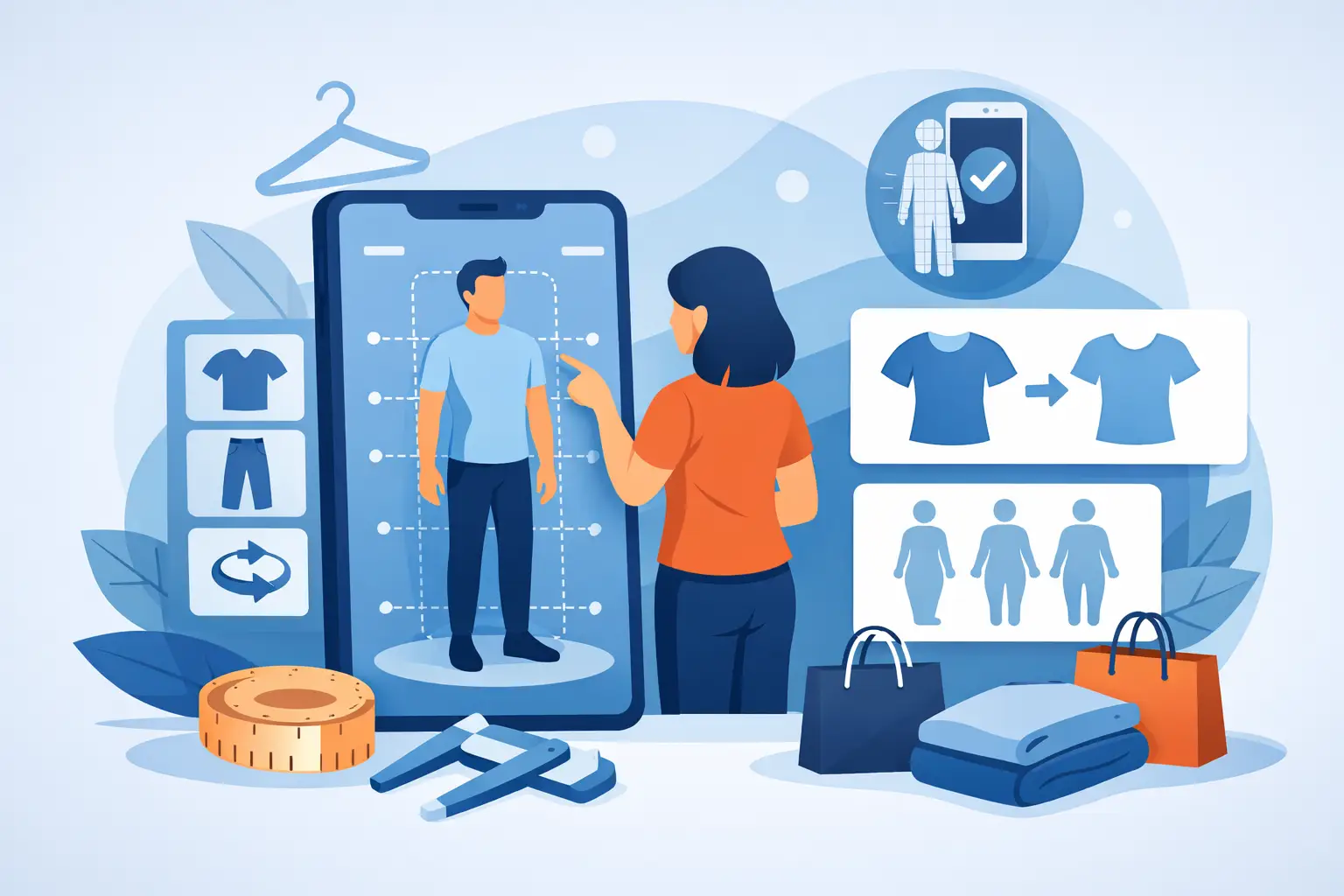
The strongest apps are moving toward a virtual fitting room model. You upload a full-body photo, the system processes the garment on your image, and you get a realistic preview fast. If it works well, you are no longer shopping in the dark. You are making a decision with visual evidence.
Why visual confidence beats size guessing
Size charts are useful, but they are not built for real-world shopping behavior. Most people are comparing items quickly, jumping between brands, and making decisions on a phone. They are not sitting down to cross-reference inseams, bust measurements, and fabric notes for every purchase.
A clothing fit app that shows the garment on your body reduces that friction. You can judge whether the hem hits where you want, whether the shape works with your proportions, and whether the overall look matches your style. That speed changes behavior. You stop adding backup sizes to your cart. You stop buying "just to see." You stop treating returns like part of the process.
There is a trade-off, though. Visual try-on is only helpful if it is credible. If the output looks overly filtered, flat, or obviously fake, trust drops fast. Shoppers do not need perfection, but they do need realism strong enough to support a buying decision.
The 4 features that separate a good clothing fit app from a gimmick
The first is speed. If an app takes too long to generate results, most users will abandon it. Shopping is momentum-driven. Waiting a minute for each outfit preview feels slow. Waiting around 10 seconds feels usable. That gap is the difference between a novelty and a real shopping utility.
The second is visual accuracy. Not every virtual try-on engine handles drape, proportion, and placement equally well. Some apps paste clothing onto a body like a sticker. Better systems account for body shape and how the garment sits visually. That creates a result you can actually evaluate, not just admire for the tech.
The third is privacy. This is non-negotiable when a product asks for personal photos. Shoppers want convenience, but not at the cost of control. Encrypted processing and automatic photo deletion are the kind of safeguards that remove hesitation. If an app is vague about what happens to your image, that uncertainty can kill adoption before the try-on even starts.
The fourth is what happens after the preview. A strong clothing fit app should not make every session start from zero. Saving looks, comparing outfits, and revisiting items later makes the tool more useful over time. That is where wardrobe features and outfit management move an app from one-time curiosity to everyday habit.
Clothing fit app expectations are changing fast
A year ago, many shoppers were still impressed by the idea of virtual try-on. Now the bar is higher. People expect the experience to be quick, clean, and convincing on mobile. They also expect it to fit naturally into the way they already shop - scrolling, screenshotting, comparing, sharing, and deciding fast.
That shift matters because it changes how success is measured. The best clothing fit app is not the one with the flashiest demo. It is the one that helps real shoppers make better decisions with less effort. That means fewer abandoned carts, fewer returns, and fewer purchases that looked good on the model but wrong everywhere else.
For style-conscious users, there is another layer. They are not only asking, "Does this fit?" They are asking, "Does this work for me?" Those are different questions. Fit is technical. Personal style is visual and emotional. An app that can support both has a much stronger reason to stay on someone’s phone.
Where AI makes the biggest difference
AI is not valuable here because it sounds advanced. It is valuable because it compresses a frustrating process into a fast one. The real win is not the technology itself. The win is getting a realistic answer before you spend money.
That shows up in three places. First, AI helps generate try-on results quickly enough for mobile shoppers. Second, it improves how garments are mapped and displayed on different bodies. Third, it can extend beyond fit into recommendations - suggesting outfit combinations, styling options, or pieces that work with what you already own.
That last point is often overlooked. Most people do not shop item by item in a vacuum. They are thinking about what goes with their sneakers, what works for an upcoming event, or whether a new jacket fits into the rest of their wardrobe. A clothing fit app becomes much more useful when it helps organize and build looks rather than just preview single products.
This is where a product like Prova feels aligned with how people actually shop. Fast virtual try-on, realistic output, privacy safeguards, and a built-in wardrobe feature make the experience more practical than a one-off tech demo. It turns try-on into a repeatable decision tool.
What shoppers should be skeptical about
Not every claim deserves immediate trust. If an app promises perfect sizing for every brand, be cautious. Apparel sizing is inconsistent by nature, and no tool can fully erase that. A good app can reduce uncertainty dramatically, but it cannot override bad manufacturing standards or misleading retailer product photos.
You should also be careful with apps that treat privacy as a footnote. Uploading a full-body photo is a meaningful step. Clear language around encrypted connections and automatic deletion is not just nice to have. It is part of the product.
And then there is the realism question. Some users expect virtual try-on to predict exact fabric behavior, down to stretch and texture under movement. That is not always realistic. The best results usually support decision-making rather than act as a perfect simulation. If the app helps you rule in or rule out a purchase with much more confidence, it is doing its job.
How to judge whether a clothing fit app is worth using
Start with one item you would normally hesitate to buy online. Something with shape, not just size - maybe a blazer, a dress, or wide-leg pants. If the app can show you a believable preview quickly, that is a strong sign. If the output feels generic or the process feels cumbersome, you probably will not use it twice.
Then pay attention to the workflow. Good apps feel simple from photo upload to final preview. Great ones let you save looks, compare options, and come back later without friction. That matters because shopping decisions are often delayed, not instant. You might like an item today and buy it three days later. Your try-on history should support that behavior.
Finally, ask whether the app gives you more confidence than your current routine. If you still need to order two sizes, read twenty reviews, and hope for the best, the tool is not doing enough. The right app should make the decision easier, not add another layer of work.
Shopping for clothes online is not getting simpler on its own. The catalogs are bigger, the sizing is still inconsistent, and the cost of getting it wrong is still your time. A clothing fit app earns its place when it replaces uncertainty with a quick, realistic answer you can trust - and that is the kind of progress worth keeping in your pocket.