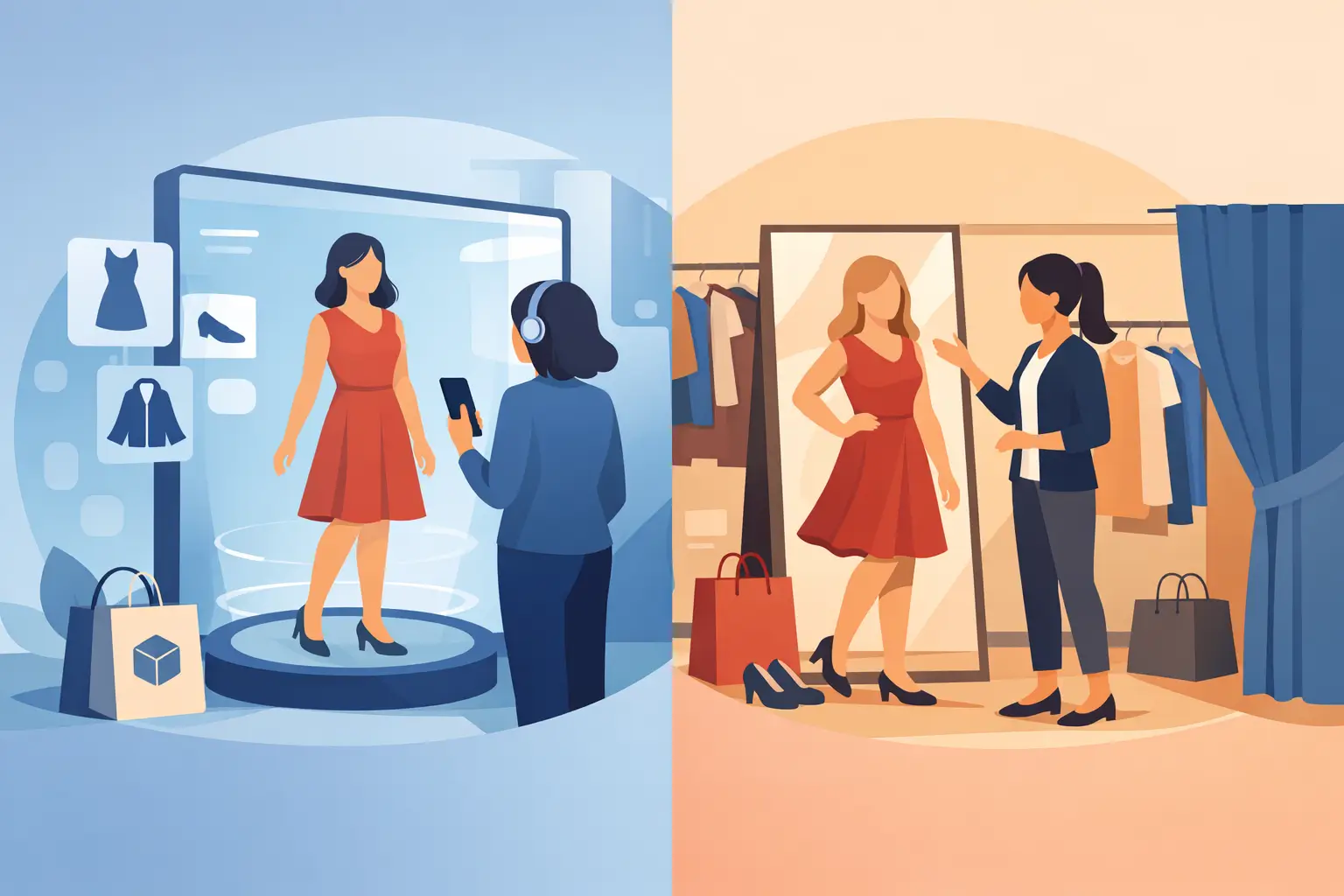
You find a jacket you like, add two sizes because you are not sure, and already know one of them is coming back. That is the real cost of shopping without confidence. When people compare a virtual fitting room vs in store fitting, they are usually asking a simpler question: which one helps me make the right call faster?
The answer is not one-size-fits-all. Physical fitting rooms still solve some problems better. But for a growing share of everyday shopping, especially online shopping, virtual try-on is becoming the smarter first step because it removes friction before you ever hit buy.
Virtual fitting room vs in store fitting: what actually changes?
The biggest difference is where uncertainty shows up.
With in-store fitting, you handle uncertainty after you have already traveled, browsed, picked items, and waited for a room. You get a real-world answer, but only at the end of the process. With a virtual fitting room, you move that decision earlier. You can see how a piece looks on your body before ordering, before standing in line, and before creating a return.
That shift matters more than it sounds. Most shoppers are not trying to conduct a perfect garment analysis. They want quick visual confidence. Does this silhouette work on me? Is this color flattering? Does this top feel too boxy with my proportions? A strong virtual try-on experience answers those questions in seconds.
For shoppers who browse often, buy online regularly, or compare multiple looks, speed changes behavior. You test more options, second-guess less, and narrow your choices sooner.
Where in-store fitting still wins
Physical fitting rooms still have one major advantage: tactile reality.
You can feel the fabric, check stretch, assess lining quality, and notice details that a digital preview cannot fully communicate. If you are shopping for denim, structured blazers, formalwear, or anything where fabric weight and movement are critical, trying the item on in person can still be the final decision-maker.
In-store fitting also helps when brand sizing is wildly inconsistent. Even the best visual try-on cannot fully replace the experience of moving around in a garment, sitting down, raising your arms, or checking whether a waistband digs in after five minutes.
But there is a trade-off. In-store fitting is accurate in a narrow, literal sense, yet often inconvenient in practice. Stores may not have your size. Lighting can be harsh or misleading. Mirrors can distort. Fitting room lines eat time. And if you are comparing options from different retailers, the process becomes slow fast.
So yes, in-store fitting can give you a higher-confidence final check. It is just a more expensive one in time and effort.
Where virtual fitting rooms pull ahead
For most digital-first shoppers, the real value of a virtual fitting room is not replacing every fitting room visit. It is reducing how often you need one.
A good virtual fitting room lets you upload a full-body photo, preview clothing on your body, and get a realistic sense of fit and styling almost immediately. That means you can filter out obvious misses before spending money or making a trip.
This is where speed matters. If try-on takes too long, people stop using it. If it takes about 10 seconds, it becomes part of normal shopping behavior. You can compare tops, dresses, jackets, or full outfits in a way that feels practical, not experimental.
Virtual try-on also solves a problem physical stores cannot: wardrobe context. In a store, you see one item in isolation, often under bad lighting, with the clothes you wore that day. In a virtual environment, you can revisit looks, compare combinations, and make better styling decisions over time. That is especially useful for people building outfits instead of making one-off purchases.
For online shoppers, this is the difference between guessing and previewing.
Accuracy is not just about fit
When people hear "accuracy," they usually think size. But that is only part of the story.
A useful fitting experience needs to answer three separate questions. First, will this look proportionate on my body? Second, does this style match how I want to present myself? Third, is this worth buying compared with my other options?
In-store fitting handles the first question well and the second one reasonably well. Virtual fitting rooms can handle both the first and second question quickly, and they often do a better job on the third because they make comparison easier.
That is why the virtual fitting room vs in store fitting conversation should not be framed as digital versus real. It is more accurately first-pass confidence versus final-pass confirmation.
If you are choosing between ten dresses online, a virtual fitting room is often the better tool. If you are deciding whether one specific pair of trousers bunches at the ankle, in-store fitting may still be better. Different stages, different strengths.
Convenience is not a small feature
Convenience gets treated like a bonus. It is not. It directly affects decision quality.
When shopping is slow or annoying, people make worse calls. They settle. They rush. They buy backups. They postpone decisions until checkout and then abandon the cart. Friction creates uncertainty, and uncertainty creates returns.
Virtual fitting rooms remove several layers of friction at once. There is no commute, no dressing room wait, no repeated changing, no pressure from store traffic, and no need to remember how five outfits looked an hour apart. You can try options on your own time, in your own space, and revisit them later.
That last part is underrated. The ability to save looks and compare them later makes shopping more rational. You stop relying on memory and start relying on visual proof.
For busy shoppers, that is not just convenient. It is efficient.
Privacy is a real factor in the choice
Not everyone loves stepping into a public fitting room area, especially when stores are crowded or mirrors are positioned badly. Shopping for certain categories can feel uncomfortable, rushed, or overly exposed.
Virtual fitting shifts the experience into a private setting. That alone makes it more approachable for a lot of users. But privacy only counts if the technology is trustworthy.
Any app handling personal photos should make security clear, not vague. Encrypted processing and automatic photo deletion matter because they remove a major barrier to adoption. People will use AI shopping tools more often when they know their images are handled securely and not stored indefinitely.
That reassurance changes virtual try-on from a novelty into something usable every week.
What this means for returns
Returns are usually a symptom, not the main problem. The real problem is uncertainty at the moment of purchase.
In-store fitting reduces uncertainty by giving you the item physically. Virtual fitting reduces uncertainty by giving you a realistic preview before ordering. Both can lower returns, but they do it differently.
In-store fitting helps when you are already at the store. Virtual fitting helps at scale, before shipping happens at all. That is why it has such strong appeal for frequent e-commerce buyers. If you shop online often, even a small bump in decision confidence can save a surprising amount of time and money over a year.
This is also where a tool like Prova fits naturally into the modern shopping flow. Fast AI try-on, secure processing, and the ability to save outfits in one place make it easier to move from maybe to yes without buying three versions of the same thing.
So which one should you use?
If your goal is the highest-confidence final check on fabric feel and physical comfort, in-store fitting still has a place. If your goal is to shop faster, compare more options, and avoid obvious mistakes before you buy, virtual fitting rooms are the stronger tool.
For most people, the smartest answer is not either-or. Use a virtual fitting room as your first filter, then use in-store fitting when the item or occasion really justifies it. That gives you speed where speed matters and physical confirmation where it truly counts.
Shopping is getting more visual, more mobile, and more immediate. The winning experience is the one that helps you decide with less friction and more certainty. If a tool can show you how something looks on you in seconds, keep your photos secure, and help you avoid another return label, that is not a gimmick. That is progress worth using.