You know the moment. A jacket looks sharp on the product page, the reviews say it runs "mostly true to size," and you still have no idea whether it will actually work on you. That gap between seeing clothes on a model and seeing them on your own body is where most online shopping mistakes happen.
That is exactly why more shoppers want to upload photo try on clothes before they buy. It is faster than ordering multiple sizes, more useful than staring at a size chart, and a lot less annoying than making another return.
Why upload photo try on clothes is catching on
Online shopping got very good at showing products. It still struggles with showing personal fit and styling. A model photo can tell you what a dress looks like. It cannot tell you how that dress will sit on your frame, whether the hem feels balanced on your height, or if the color works with your usual shoes and outerwear.
When you upload a photo and try on clothes digitally, you close that gap. You get a visual answer instead of a guess. For a lot of shoppers, that changes the buying decision from "maybe" to "yes" or "no" much faster.
The appeal is simple. You save time, reduce return risk, and get more confidence before checkout. If you shop often, those small wins add up quickly. Even if you only buy clothes once in a while, seeing an outfit on yourself is usually more helpful than reading ten review comments from people with completely different proportions.
What this experience actually helps with
The biggest benefit is not magic sizing precision. It is visual certainty.
That matters because most apparel decisions are not purely about whether something technically fits. They are about proportion, shape, color, and overall vibe. A coat can fit and still feel too boxy. Jeans can be the right size and still throw off the balance of your outfit. A top can look great alone and clash with everything else you already own.
Virtual try-on helps you answer those questions sooner. It lets you see whether a silhouette works, whether a piece feels flattering, and whether it fits your style in a real-world way. That is useful for trend pieces, occasionwear, work clothes, and basics.
It also helps with comparison. If you are deciding between two cuts of the same blazer or three shades of the same sweater, seeing them on your own photo is often more decisive than toggling between product thumbnails.
How upload photo try on clothes works
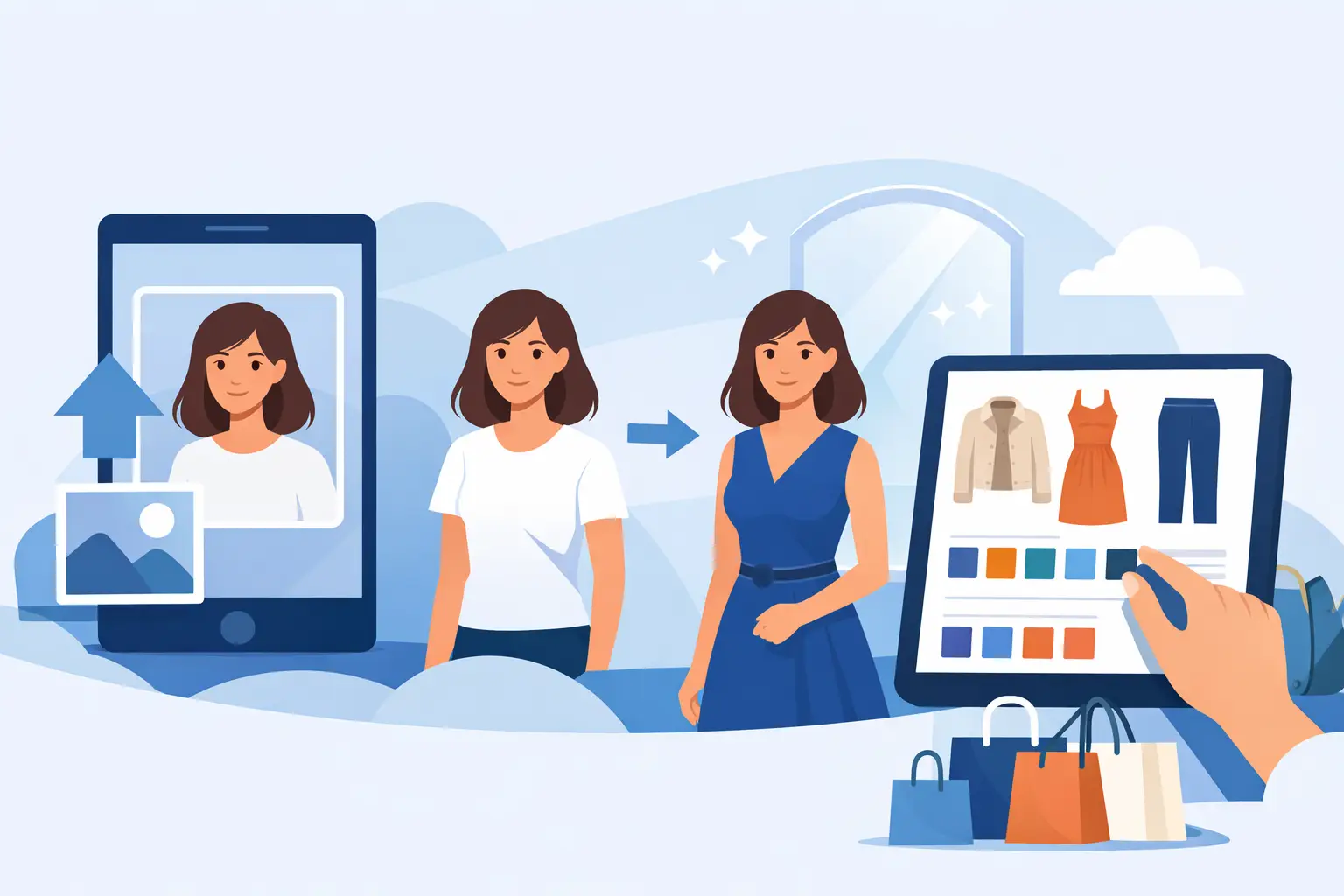
At a practical level, the process is usually straightforward. You upload a full-body photo, select the clothing item you want to preview, and the system uses AI to generate a try-on image. The best tools do this quickly, so you are not waiting around for a result.
What makes the result useful is how well the system handles body shape, garment placement, and visual realism. If the clothing sits naturally, follows your pose well, and preserves enough detail to judge style, the output becomes a shopping tool instead of a gimmick.
Speed matters here more than people expect. If a result takes too long, most shoppers will not use it consistently. Fast processing makes virtual try-on feel like part of normal shopping behavior, not an extra task.
Privacy matters just as much. Uploading a personal photo is a trust decision. Shoppers want to know that their images are transmitted securely, handled responsibly, and not sitting around longer than necessary. Clear security practices are not a bonus feature. They are part of whether the experience feels usable at all.
What to look for in a virtual try-on app
Not every app that promises virtual fitting delivers the same value. The difference usually comes down to four things: realism, speed, privacy, and what happens after the try-on.
Realism is the obvious one. You need an image that is good enough to support a buying decision. If the garment looks pasted on, or the shape feels off, the result creates more doubt instead of less.
Speed is what turns the feature into a habit. A near-instant result makes it easy to test multiple pieces, compare options, and keep moving.
Privacy is non-negotiable. Look for encrypted connections and clear photo handling policies. If an app does not explain how your image is protected or whether it is deleted after processing, that is a red flag.
Then there is the part many shoppers overlook: outfit management. Trying on one item is useful. Saving looks, revisiting combinations, and organizing pieces you are considering is where the experience starts to feel genuinely practical. If you shop across different stores or like planning outfits ahead of time, this becomes a real advantage.
Where virtual try-on is strongest and where it still depends
AI try-on is especially strong for styling decisions. It helps with broad silhouette, layering, color pairing, and whether a piece feels right on your body at a glance. That alone can prevent a lot of bad purchases.
But there are trade-offs. Fine-grain fit details can still depend on the garment and the input photo. Fabric stretch, lining, structure, and exact cut can affect how something feels in real life. A digital try-on is best used as a confidence tool, not a perfect substitute for every physical detail.
That is not a weakness so much as the right expectation. If you are choosing between pieces, narrowing options, or checking whether something suits you before you buy, it is extremely useful. If you need to know whether a pair of tailored pants will feel snug at the waist after sitting for eight hours, there is still a limit to what an image alone can tell you.
For most shoppers, though, the biggest pain point is not microscopic precision. It is uncertainty. Virtual try-on reduces that fast.
A better shopping flow for real people
The smartest way to use this technology is not to replace your judgment. It is to support it.
Start with a clear, full-body photo in good lighting. That gives the system better input and gives you a more believable result. Then test the pieces you are genuinely considering, not just random items for entertainment. Compare alternatives side by side if the app allows it, and pay attention to proportion first. Ask yourself whether the garment works with your shape, your style, and what you already own.
This is where a built-in wardrobe feature becomes more than a nice extra. Saving outfits gives you a second look later, which is helpful when you are tempted by impulse buys. An item that looked exciting in the moment may not hold up next to the rest of your saved looks. On the other hand, a piece you were unsure about may prove surprisingly versatile.
That kind of review process leads to better decisions. Fewer duplicate purchases. Fewer regret orders. Fewer boxes going back.
Why this matters beyond convenience
Shopping with more certainty is not just about saving five minutes. It changes how you buy.
When you can see clothing on yourself before checkout, you are less likely to over-order "just in case." You are also less likely to settle for items that are technically fine but never become favorites. The result is a closet with more intention and less waste.
That is one reason this category is growing fast. People want convenience, but they also want control. They want to experiment without the friction of a dressing room and without the risk of repeated returns. They want to make quicker choices without feeling blind.
A strong app can deliver that in about 10 seconds. If it also keeps your photos encrypted, automatically deletes them after processing, and lets you save looks in one place, it starts to feel less like a novelty and more like a better way to shop. That is the promise behind platforms like Prova at https://prova.studio.
Should you use it before every purchase?
If you shop online often, probably yes. Not because every single item requires deep analysis, but because the habit is efficient. A quick try-on can confirm a choice, rule one out, or help you compare similar options without guesswork.
If you shop less often, it still makes sense for higher-stakes purchases. Think dresses for events, coats, denim, workwear, or anything outside your usual style. Those are the moments where visual confidence matters most.
And if you simply enjoy experimenting with fashion, this is one of the easiest ways to test ideas without committing to them first. That mix of utility and fun is a big reason virtual try-on is sticking.
The best part is not that AI makes shopping feel futuristic. It is that it makes one of the most frustrating parts of online shopping feel manageable. When you can see more clearly before you buy, you usually buy better.