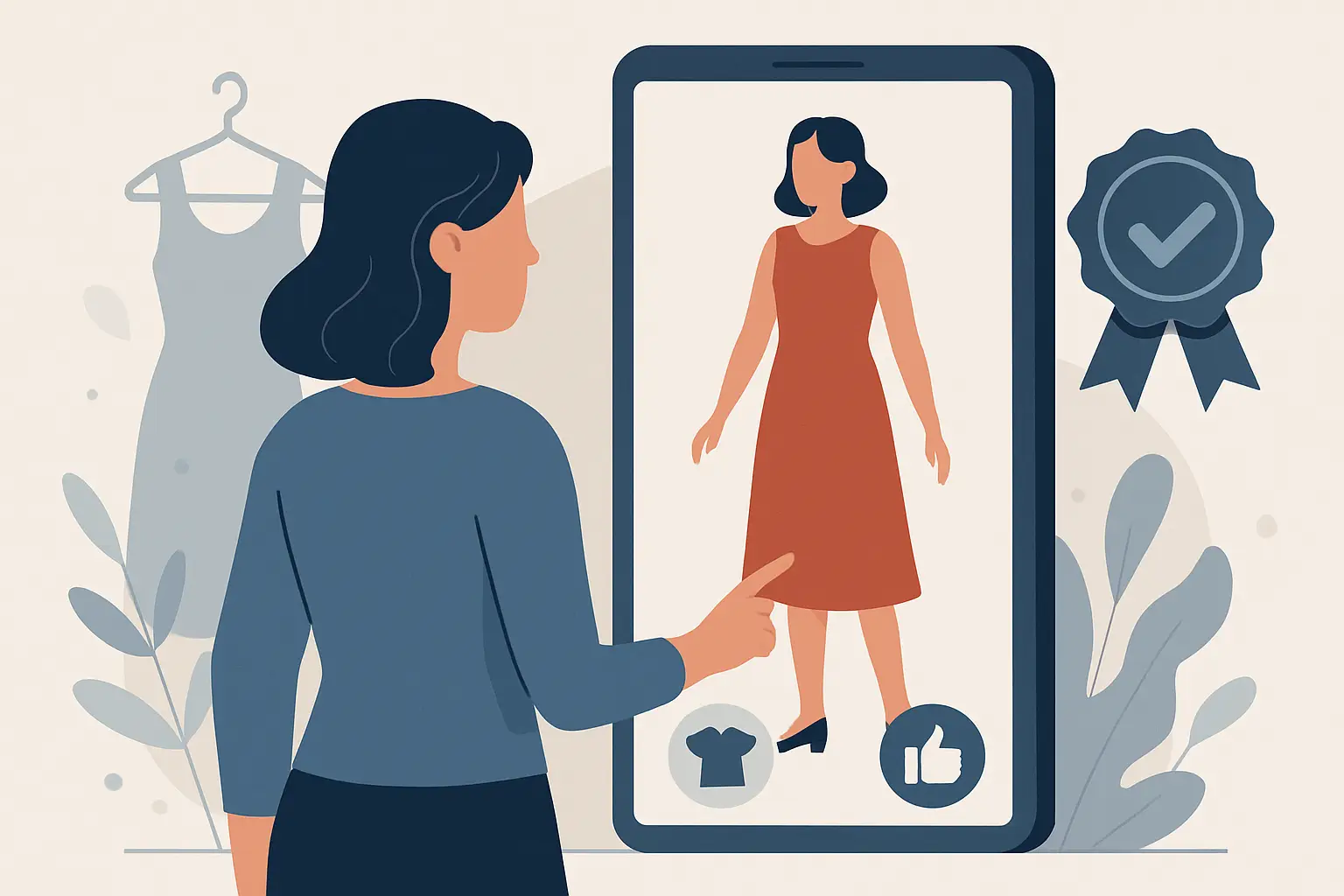
If you have ever added three sizes to your cart “just in case,” you already know what a virtual fitting room is really competing with: the cost of uncertainty. Not just money, but time, porch clutter, and the mental load of returns.
The best virtual fitting room app is the one that removes that uncertainty fast, shows you something you can trust on your body, and does it without turning your photos into a privacy trade.
What “best” actually means for a virtual fitting room app
A virtual fitting room app can look impressive in a demo and still be disappointing the moment you try it with your real closet, your lighting, and a garment that is not perfectly photographed. “Best” is less about flashy tech terms and more about repeatable outcomes: you make a decision faster, you feel confident enough to keep what you buy, and you actually want to use it again.
In practice, the best apps nail four fundamentals: speed, realism, privacy, and outfit management. Miss any one and the experience becomes a novelty instead of a habit.
The checklist for the best virtual fitting room app
Speed: the 10-second rule
Virtual try-on only works when it fits into how people shop. Most of us are comparing options on a phone between meetings, on the couch, or in a store aisle. If a try-on takes long enough that you drift into another app, the moment is gone.
A strong target is results in about 10 seconds for a full-body try-on. That is quick enough to support rapid comparison across colors, sizes, and similar styles. It is also quick enough to encourage experimentation, which is where confidence gets built.
Trade-off: the fastest systems often rely on cloud processing. That can be a win for performance, but it raises the bar for privacy. You want speed, but you should not have to worry about where your photos end up.
Realism: fit cues you can actually use
A virtual fitting room should not just paste a shirt on top of a photo. It should help you answer the questions that trigger returns:
Does the shoulder line sit where it should? Does the waist look shaped or boxy on me? Is the hem where I like it? Does this color flatter my skin tone in normal lighting?
You are looking for believable drape and proportion, and a try-on that respects your body shape. “Stunning accuracy” is not a marketing flourish when it helps you eliminate the two most common purchase mistakes: buying the wrong silhouette for your frame and buying a piece that only looks good on the model.
Trade-off: realism depends on input quality. If your full-body photo is too dark, cropped, or taken at an extreme angle, even great AI will struggle. The best apps guide you toward a usable photo without making setup feel like homework.
Privacy: clear policies, not vague reassurance
A fitting room app asks for something personal: a full-body photo. If privacy is handled casually, you will use the app once and then delete it.
Look for concrete protections you can understand in one read: encrypted connections, automatic photo deletion after processing, and controls that avoid unnecessary data retention. “We respect your privacy” is not enough. The best apps are explicit about what happens to your images, when they are deleted, and what you can do to remove data.
Trade-off: stronger privacy practices can limit certain social features or long-term personalization. That is fine if the app still lets you save outfits in a way that does not require keeping raw photos forever.
Wardrobe and outfit management: the difference between a tool and a habit
People do not just want to see one item on their body. They want to compare.
The best virtual fitting room app helps you organize looks so you can revisit decisions later. That means a built-in wardrobe where you can save outfits, group them by occasion, and pull them up when you are about to buy. It is also the foundation for smarter recommendations, because the app can learn what you actually wear, not just what you tried once.
Trade-off: wardrobe features can get cluttered fast if the app does not keep saving friction low. If it takes too many taps to capture a look, you will stop doing it.
Best virtual fitting room app features that matter most
There are a lot of features that sound good in app store descriptions. In real shopping, a few details do most of the work.
Full-body try-on, not just tops
If an app only handles a single garment type well, it limits how useful it is for real outfits. Full-body support is what lets you judge proportions across a look: cropped jacket with high-rise jeans, long coat with boots, oversized sweater with a skirt.
Consistent results across different clothing images
Most shoppers are using product photos from different sources: brand sites, resale listings, social posts, and screenshots. The best apps can produce stable try-ons even when the garment image is not studio-perfect.
You do not need perfection. You need consistency, so your comparisons are fair.
Fast iteration for comparison shopping
The best experience is not “try this once.” It is “try five options quickly and pick the one you feel best in.” That means the app should make it easy to swap garments and keep your base photo.
Style tips that feel like a friend, not a lecture
AI styling is only helpful when it is specific. Generic advice like “pair with jeans” does not change outcomes. Useful tips sound more like: this neckline balances broad shoulders, this length elongates the leg, this color works with warm undertones, this sneaker style keeps the look casual.
It also needs to respect preference. If you dress minimal, you do not want maximalist suggestions. The best apps learn from what you save.
How to choose the best virtual fitting room app for you
Start with your shopping behavior, not the feature list.
If you are a frequent online buyer who hates returns, prioritize realism and speed. You want quick, repeatable try-ons that help you confidently choose one size and move on.
If you are a social shopper who loves experimenting, prioritize wardrobe tools and shareable looks. You want to save outfits, compare options, and get feedback without losing track of what you tried.
If you are privacy-first, make that non-negotiable. Choose an app that clearly states encrypted processing and automatic deletion. If you cannot find those claims, assume the policy is not strong enough for comfort.
A quick workflow that actually works
A virtual fitting room is only valuable if it fits into your normal routine. Here is what a high-performing workflow looks like in real life.
You start with one clear full-body photo and keep it as your baseline. You then test a few items you are considering, especially pieces where fit risk is high: jeans, dresses, fitted tops, and jackets. You save the top contenders as outfits, not just single try-ons, because your final decision is almost always “does this work with what I already own?”
Finally, you compare looks side by side before you buy. If an app makes that last step easy, you will feel the difference immediately in fewer impulse purchases and fewer returns.
Where virtual fitting rooms still struggle (and how to shop smarter anyway)
Even the best virtual fitting room app is not a perfect substitute for fabric in your hands.
Texture, stretch, and thickness are still hard to judge from images. If you are buying something where fabric is the whole point, like a sweater, a bodycon dress, or linen, use try-on to validate silhouette and length, then lean on product details for material.
Sizing across brands remains messy. Virtual try-on can help you see how a cut might look, but it cannot fully standardize sizing charts. You will still want to check measurements when you are between sizes.
Lighting and photo angle matter. If your baseline photo is taken in harsh overhead light, colors can look off. Take your photo in even, natural light when possible and keep your posture neutral so comparisons stay honest.
Why some apps feel “fun” but not useful
A lot of try-on tools get downloaded because they look entertaining. The problem is they often fail the confidence test.
If the result looks like a sticker, you cannot trust it. If it takes too long, you will not use it. If privacy is unclear, you will not upload a full-body photo again. The “best” label is earned when the app becomes part of your buying decisions, not just something you show a friend once.
One example of a best-in-class approach
Apps that perform well tend to combine near-instant cloud processing with clear privacy protections and a built-in wardrobe so you can save and revisit looks. Prova, for example, is designed around full-body virtual try-on in about 10 seconds, encrypted connections, automatic photo deletion after processing, and a “My Wardrobe” area for managing outfits and getting style recommendations. If you want to see what that experience feels like, you can start at https://prova.studio.
The buying confidence test
Here is the simplest way to evaluate any virtual fitting room app: after three try-ons, do you feel more decisive?
If you are still guessing, the app is not giving you usable fit cues. If you feel confident enough to buy one option instead of three, it is working.
The best virtual fitting room app does not replace your style. It removes the friction between “I like it” and “I know it will look good on me.” Your next purchase should feel lighter, faster, and a lot more certain.