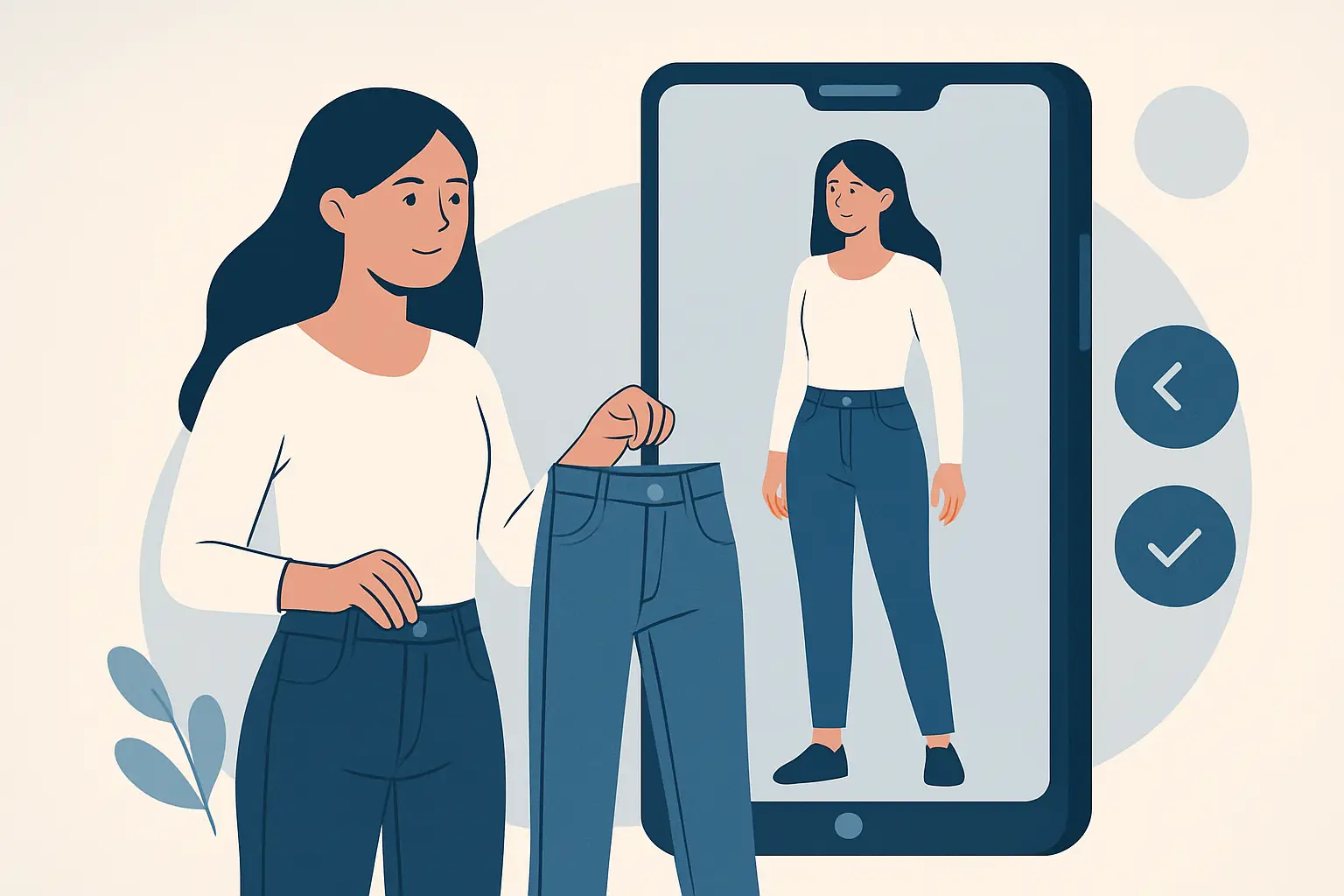
Jeans are the one item that can look “perfect” on a product page and still feel completely wrong the second you pull them on. The waist gaps. The thighs pull. The rise sits higher than you expected. Or the “straight leg” is straight on the model and somehow a tapered carrot on you.
That is why virtual try on for jeans is taking off faster than almost any other try-on category. Tops are forgiving. Dresses can be pinned mentally. Denim is math - and the math changes with rise, stretch, wash, pocket placement, and your exact proportions. When you get jeans right, you wear them nonstop. When you get them wrong, you lose time, money, and patience.
Why jeans are so hard to buy online
Most of the pain is not about “your size.” It is about how brands translate a pattern into a range of bodies and how denim behaves once it is on a real person.
Rise is the first culprit. A one-inch difference in front rise can completely change where the waistband sits, how the zipper lays, and whether the top feels secure or constantly needs adjusting. Two jeans can both be labeled “high-rise” and feel like different categories.
Then there is stretch. A rigid 100% cotton jean will hold its shape and telegraph every fit issue immediately. A stretch blend can feel great for an hour and then relax into something baggy by lunchtime. Even within stretch, recovery varies - some denim snaps back, some gives up.
Leg shape creates the next wave of surprises. A “straight” jean on a model with one set of proportions can read as skinny on someone with more thigh, or look slouchy on someone with narrower legs. Add in the fact that inseam is only half the story - knee placement and taper matter too - and you get why people end up ordering three sizes and two silhouettes just to land on one keeper.
Finally, wash and details change the visual fit. A dark rinse is more slimming. A faded thigh can make legs look wider. High-contrast whiskering draws attention exactly where you might not want it. Pocket size and placement can lift or flatten your look. None of that shows up clearly in a size chart.
What “virtual try on” really means for denim
Virtual try-on is not a gimmicky filter that pastes jeans onto a selfie. Done well, it is a fit-and-visualization tool: you upload a full-body photo and the system maps how a specific garment would appear on your body.
For jeans, the best experience focuses on three outcomes.
First, proportion. You want to see where the waistband lands relative to your torso, how the rise reads, and how the leg shape balances your frame. A true try-on helps you stop guessing based on model photos.
Second, silhouette. Jeans are architecture. A good try-on should make it easy to compare a straight leg versus a wide leg, or a high-rise versus a mid-rise, without you becoming your own dressing room.
Third, styling. Denim rarely lives alone. The right question is not just “Do these jeans fit?” but “Do these jeans fit with my shoes, my jacket, and the tops I actually wear?” Virtual try-on earns its keep when you can test the full look quickly.
Where virtual try on for jeans wins (and where it depends)
The big win is speed-to-clarity. Instead of ordering, waiting, trying on, repacking, and returning, you can see how a cut and wash are likely to read on your body before you buy.
Virtual try on for jeans also makes comparison shopping feel sane. When you are deciding between two rises or two leg shapes, you do not need perfect realism to get value - you need consistent visualization. Seeing the options on the same photo of you eliminates a ton of mental noise.
It also reduces “closet mistakes,” not just returns. Many jeans technically fit, but do not fit your style. If you always wear cropped jackets, you might prefer a higher rise. If you live in oversized shirts, you might want less volume through the hip. Try-on helps you see those interactions.
Now the trade-offs. If you want a definitive answer on whether the waistband will pinch when you sit, virtual try-on cannot feel fabric. If your main problem is sensory comfort, you still need to pay attention to materials and reviews.
Hem length is another “it depends.” Virtual try-on can show the vibe of cropped versus full length, but exact break over your sneaker or boot is influenced by inseam options, shrinkage, and how the brand finishes the hem.
And if you are in-between sizes in a brand that runs inconsistent, you will still want a backup plan. Virtual try-on helps you choose smarter, but it does not rewrite a brand’s sizing.
How to get the most accurate results
Start with the photo. A full-body shot in good light, taken straight-on, gives the system the cleanest read. Avoid mirror shots with heavy distortion, extreme poses, or wide-angle lens warping. If you want your jeans decision to be fast, your input should be simple.
Wear fitted clothes in the photo if you can. Baggy sweats or a giant hoodie can hide the waist and hip lines that matter most for denim visualization.
Next, be intentional about what you are comparing. If you are trying to solve a specific issue - waist gapping, thigh tightness, or feeling swallowed by fabric - pick jeans that differ in one key variable at a time. Compare two rises first, then compare two leg shapes. You will learn your preferences faster.
Finally, style it the way you would actually wear it. Put the jeans against the shoes you live in and the jacket you reach for. The fastest way to regret jeans is buying a pair that only works in theory.
What to look for in a jeans try-on app
Not all try-on experiences are built for denim. Jeans are less forgiving visually than a loose top, so the bar should be higher.
Prioritize speed. If try-on takes a minute per look, you will stop experimenting. The best tools make it easy to test multiple washes, rises, and silhouettes in one sitting.
Look for realism that supports decisions, not perfection for its own sake. You want clean edges, believable drape, and a stable silhouette from look to look. The goal is confidence, not cinema.
Privacy should be explicit, not implied. You are uploading a full-body photo. You should see clear language about encrypted connections and what happens to your images after processing.
And if you like to shop like a strategist, a wardrobe feature matters. Saving looks and revisiting them later turns try-on from a one-time novelty into an actual shopping workflow.
If you want a consumer app that’s built around fast processing and privacy-first handling, Prova is designed to generate realistic try-on results in about 10 seconds, with encrypted connections and automatic photo deletion after processing. It also lets you save and organize outfits so you can compare options without starting over every time.
The denim decisions virtual try-on helps you nail
The first is rise. If you have ever ordered “high-rise” and felt like you were wearing a denim corset, or ordered “mid-rise” and spent the day pulling your jeans up, you already know this is the make-or-break variable. Try-on lets you see where the waistband sits on your torso, which is often more helpful than reading an inch measurement on a chart.
The second is leg silhouette. Wide leg, slim straight, barrel, bootcut - these are not just trend labels. They change how your whole outfit reads, especially with different shoes. Seeing the silhouette on you makes it easier to pick jeans you will actually repeat-wear.
The third is wash and detailing. A clean dark wash can look more polished for work. A light wash can feel casual and relaxed. Distressing can shift the vibe instantly. Virtual try-on makes these choices visual instead of theoretical.
The fourth is styling compatibility. If you are buying jeans for a specific purpose - office days, travel, nights out, or campus life - you can test whether the jeans match your real closet. That is where a “My Wardrobe” style approach changes outcomes. You stop buying one-off jeans and start building a rotation.
A smarter way to shop jeans without the return treadmill
If you are used to ordering multiple sizes with the expectation you will return most of them, you are not alone. Denim has trained people to treat shopping like a logistics problem.
Virtual try-on flips that dynamic. You can do the experimentation upfront, see the likely silhouette on your body, and narrow your buys to pairs that make sense. It is not magic, and it will not replace fabric feel, but it can remove the biggest source of friction: uncertainty.
The next time you are about to buy jeans, do not ask, “What size am I?” Ask, “What rise and silhouette am I trying to get?” When you can see that answer in seconds, shopping stops being a gamble and starts being a decision you actually control.